See What Happens When We Power Your CMDB With Agentic AI.
Take a CMDB that knows your infrastructure cold — every asset, every relationship, every owner, every vulnerability, every dependency.
Now put agentic AI on top of it.
Here's what happens.
Offboardings finish in ninety seconds — while the people who used to do them are still in standup. Vulnerability queues drop from 800 CVEs to twelve that actually apply. Change risk reviews land inside the ticket before the CAB meeting starts. Incidents arrive with the affected systems, the dependent services, the recent changes, and the probable root cause already attached. Compliance evidence assembles itself as a side effect of operations, not as a quarterly fire drill.
This isn't theory. This is what's shipping today.
It works for one reason: agents don't fail in IT operations because the AI is bad. They fail because the AI doesn't know what it's looking at.
A CMDB-grounded agent knows. That's why the CMDB — the one nobody loved, the one that always felt slightly out of date — just became the most valuable asset in IT operations.
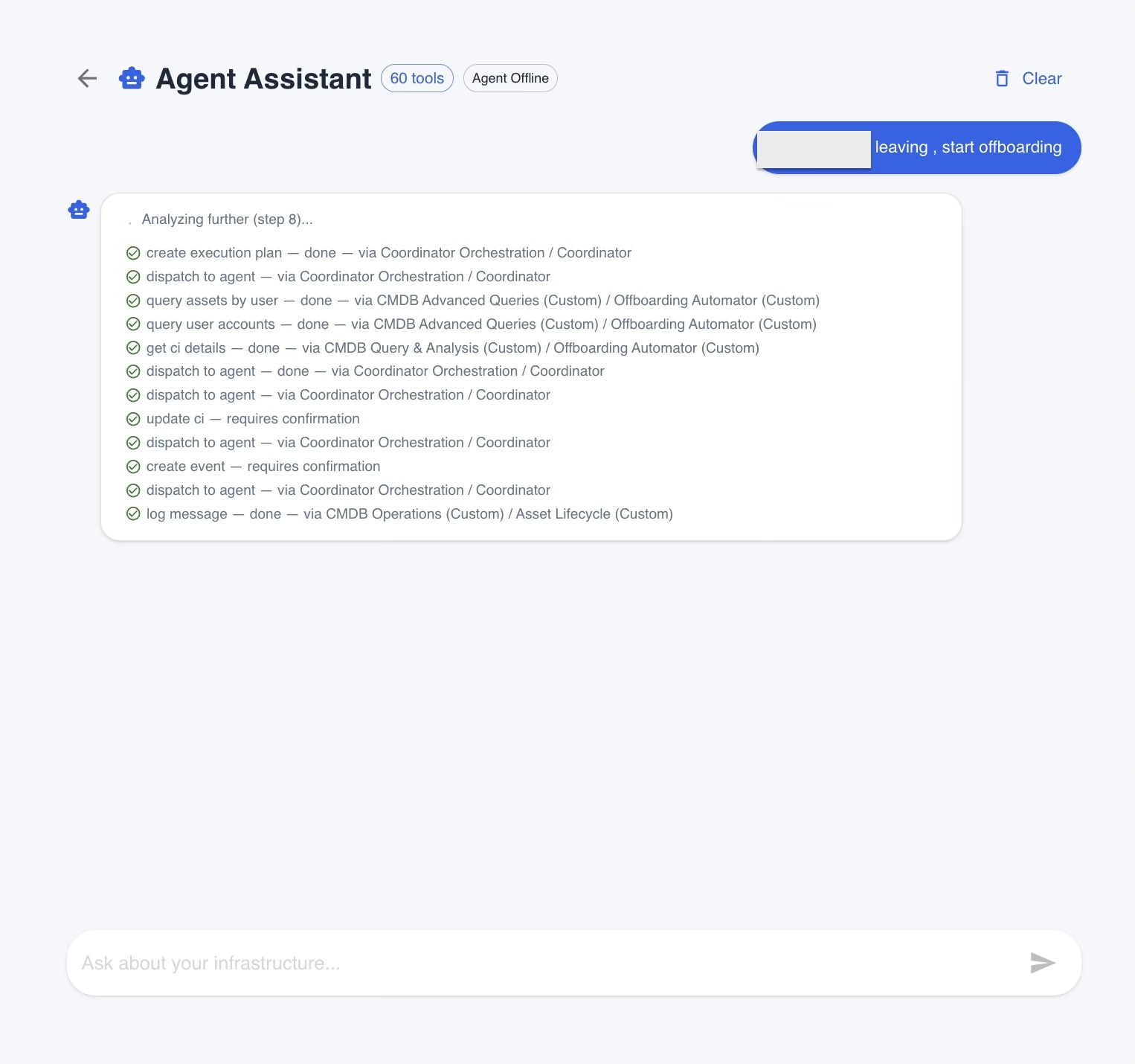
One prompt. One execution plan. The Coordinator dispatches to the Offboarding Automator and Asset Lifecycle specialists, queries the CMDB for the user's assets and accounts, stages CI updates and event creation behind approval gates, and closes with an audited log entry. This is what "agentic AI grounded in your CMDB" actually looks like.
See the full architecture in one picture: Tripl-i AI Agents — interactive overview →
Automation Is Not Orchestration
Most "AI for IT" pitches conflate two very different things.
Automation is running predefined scripts faster. Press button → script runs → result. Robotic Process Automation has been doing this for fifteen years. It's valuable, but it's brittle: the moment the input changes, the script breaks.
Orchestration is making decisions under uncertainty, in real environments, with real consequences. Should this server be restarted now? Is this CVE actually exploitable here? Does this user still need access? Who has to approve this change?
Orchestration requires context.
Automation needs a script. Orchestration needs a model of the world.
That model — the relationships between your systems, the business services they support, the people who own them, the policies they're subject to — has always been called something specific in IT operations.
It's called the CMDB.
Why the CMDB Just Became the Most Valuable Asset
Here's the inversion no one is talking about clearly enough.
For two decades, the CMDB was a cost center. You populated it because you had to. The data went stale because nobody depended on it for daily work. Investment was always justified by something else: compliance, audit, ITIL maturity scoring.
Agentic AI flips this entirely.
When AI agents reason about your infrastructure, they need to know:
- What is this system?
- What depends on it?
- Who owns it?
- What's its business criticality?
- What's its compliance scope?
- What changed recently?
- What's its current vulnerability posture?
- Are we in a maintenance window?
Every one of those is a CMDB question. And the quality of the agent's decision is bounded — exactly — by the quality of your CMDB's answer.
A perfect AI on stale CMDB data will make confident, plausible, wrong decisions. Fast. At scale.
A mediocre AI on a continuously discovered, relationship-aware, ownership-tagged CMDB will outperform a brilliant AI that's flying blind.
This is why "AI agent" announcements that come without a CMDB story are theater. The agent isn't the product. The grounded context is the product. The agent is just the interface.
We've made the case before that AI agents need more than prompts — they need a CMDB. The natural next question is the inverse: what does the CMDB itself become once those agents arrive?
It becomes the operating backbone of every decision an AI makes inside your environment. For the first time in IT operations history, the freshness, completeness, and accuracy of your CMDB will directly determine the safety, speed, and cost of your operations.
That's what changed.
The Real Value — In Hours, Not Hype
The economics are concrete:
Offboarding. A typical employee offboarding involves AD account disable, group cleanup, license reclamation, asset reassignment, ticket creation, and verification across four to six systems. Industry average: 3.5 hours of human engineering time per offboarding. At 50 offboardings a month per 1,000 employees, that's over 2,000 hours a year of skilled work consumed by repeatable orchestration. An agent grounded in the CMDB handles it in under two minutes, with full audit trail and dependency-aware rollback if any step fails.
Vulnerability response. A typical vulnerability scan produces 600 to 1,200 CVEs per cycle for a mid-sized environment. Up to 89% are false positives — CVEs that don't apply to the actually-installed software versions, or that are already neutralized by an existing hotfix. A version-aware, KB-correlated CMDB cuts that triage queue by an order of magnitude before a human ever sees it. What remains is short, prioritized, and actionable.
Change risk. The average failed change costs an enterprise $40,000 to $100,000 in direct and indirect costs. The most common root cause is unknown dependencies. An agent that pulls dependency context from the CMDB before the change is approved doesn't just shorten CAB meetings — it reduces failure rate.
Incident triage. First-call resolution rises sharply when the analyst opening the ticket already has the affected systems, dependent services, recent changes, and similar past incidents in front of them. The CMDB has all of that. The agent assembles it.
The pattern across all four:
The value isn't in the AI. The value is in the AI plus the CMDB.
What Tripl-i AI Agents Are
Tripl-i AI Agents are live now — purpose-built for the orchestration layer, on top of a CMDB this platform has been building for years.
One Coordinator. A dozen specialists. Every conversation, scheduled job, or service desk webhook routes through a Coordinator that plans, delegates, and verifies. Specialists each own a domain — Configuration Manager, Offboarding Automator, Vulnerability Manager, Service Desk, Identity Lifecycle, Asset Lifecycle, Windows Ops, Infrastructure Ops, VMware Ops, Web Research, Reporting, Asset Lookup. No fat agents with eighty tools and a hopeful prompt.
Plans before actions. Anything with consequences starts with an execution plan. Steps declare side effects. Dependencies are tracked. When an upstream step fails, downstream steps configured to skip on failure are skipped — preventing the half-completed offboarding where the AD account is still active but the assets have already been reassigned.
CMDB-grounded reasoning. Eight dedicated CMDB-read tools give the agent live access to configuration items, AI-scored dependencies with importance, risk, business impact, and service tags, per-CI vulnerabilities with KB-CVE correlation, ownership, criticality, software inventory, and change readiness. The agent doesn't guess blast radius. It looks it up.
Zero-trust access at the skill level. Every grant names the agent and the skill — no wildcards. Every grant carries a mandatory reason. Grants can be scoped to specific CIs through manual membership or dynamic compliance rules. Self-grants are flagged. Tenants choose their enforcement posture: disabled, log-only, or enforce.
Customer-side execution. PowerShell, SSH, HTTP, and ITSM API calls — all running on your network through the Tripl-i discovery agent. Commands signed with per-agent secrets. Cmdlet allowlists. Host allowlists. SSRF protection. Credentials never leave your environment.
Service management closes the loop. Inbound from Xurrent (4me) via signed webhook → Coordinator routes the work → action runs → result posts back to the original task or request as a note. Multi-turn conversation memory preserved per ticket. Authentication on every step.
Cost, audit, and a real stop button. Per-conversation cost rollup. Per-agent ceilings enforced per iteration. Per-job stop control that actually aborts in-flight work. Side-effect accuracy checks that flag runs where a declared email or change never fired. Auto-degradation that forces approval mode after three consecutive failures. Audit trails compliance teams accept.
Why This Can't Be Retrofitted
Vendors who started as ITSM platforms are now scrambling to add discovery and dependency mapping "natively" — with phased rollouts running through 2027.
Vendors who started as LLM platforms are wiring up generic API connectors and calling it agentic AI.
Both are solving the wrong problem.
The right problem is: build the operational truth first, then put intelligence on top of it.
That means agentless discovery across WMI, SSH, SNMP, and vCenter. Version-exact software identification. Dependency mapping with AI-assisted relationship classification. Tagging across criticality, environment, compliance, and ownership. Version-aware CVE matching. Microsoft KB to CVE correlation. Network connection-to-service-pattern tying.
That isn't "AI-ready data." That is a foundation.
You can't retrofit it. You build it from day one, or you're behind for a decade.
Tripl-i was built that way from the start. The agents are what we shipped when the foundation was already there.
The Next Twenty-Four Months
Three things will define the next two years in IT operations:
Discovery becomes existential. Organizations with stale CMDBs will be unable to deploy agentic AI safely. Organizations with continuously discovered, relationship-aware infrastructure will run circles around them. Discovery is no longer a "nice to have" — it's the foundation everything else stands on.
Specialist agents replace ticket queues. L1 work — offboarding, password reset, account provisioning, vulnerability triage, software install, change pre-checks — will move to agents that read the CMDB, plan against dependencies, execute under approval gates, and produce audit trails. Human engineers will move up the stack to architecture, exception handling, and judgment-heavy work. The headcount conversation will shift from "more L1" to "more leverage per engineer."
CMDB becomes a board-level conversation. When the freshness of your asset inventory directly governs the speed and safety of your operations, CMDB investment stops being an IT line item and starts being strategic infrastructure. CIOs will be asked about CMDB coverage the way they're asked about cloud migration today.
Organizations that prepare now — with discovery, with relationships, with governance — will compound advantages year over year. The ones that don't will find themselves running agentic AI on a foundation that can't support it.
The Bottom Line
The future of IT operations isn't an AI assistant that drafts your tickets.
It's an AI operator that reads your CMDB, plans against your dependencies, respects your approvals, executes on your network, and proves what it did.
The CMDB is the difference between an agent that helps and an agent that breaks things.
For two decades, that data was a tax.
Starting now, it's an asset — possibly the most valuable one in your stack.
Tripl-i AI Agents are live. The platform underneath them is what makes the difference.
Tripl-i AI Agents are live now. See the AI Agents infographic and architecture overview, explore the documentation, or see the full platform overview. Discovery, CMDB, vulnerability management, compliance, and service operations — one platform, one data model, one foundation. Available today, not in phases.
Related reading: AI Agents Need More Than Prompts. They Need a CMDB. — the case for why agents fail without a foundation, and why the CMDB is what makes the foundation real.